APEX
MICRO
1:4.7 scale demonstrator of the Apex Pelican quad tilt-rotor architecture. 46.6 lb aircraft weight. 284 lb total thrust. Built to win the DARPA Lift Challenge.
THE CHALLENGE
The DARPA Lift Challenge tasks competitors to build an unmanned aircraft weighing no more than 55 pounds — excluding payload — capable of lifting a minimum of 110 pounds of gym plates. The primary scoring metric is payload weight ÷ aircraft weight. The team with the highest ratio wins.
The Apex Micro is not a one-off prototype. It is a direct scale demonstrator of the Pelican's quad tilt-rotor architecture, proving the design at low cost and risk before full-scale development. Every lesson learned on the Micro directly informs the Pelican.
With 284 lb of total thrust against a 46.6 lb aircraft weight, the Apex Micro has a 6.09:1 thrust-to-weight ratio — enough to attempt payloads well above the 110 lb minimum.
1:4.7 SCALE PELICAN
Same quad tilt-rotor layout. Same autonomous flight architecture. Same swept-tip rotor geometry. The Micro is the Pelican at scale — a live proof-of-concept for the full production aircraft.
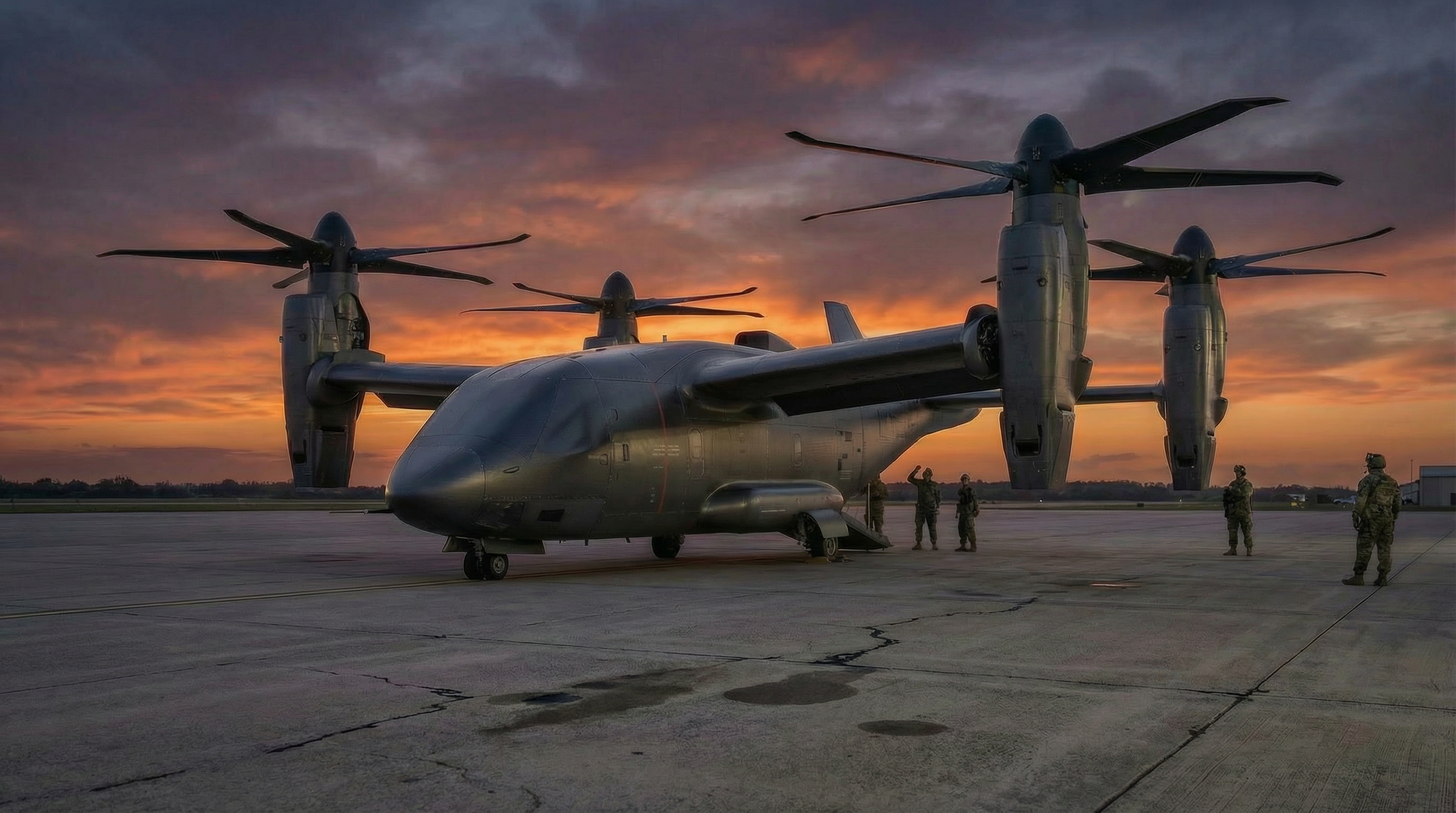
Apex Pelican — full-scale production design. The Micro demonstrates this architecture at 1:4.7 scale.
APEX MICRO — TECHNICAL SPECIFICATIONS
12S 40Ah baseline configuration · March 2026
Battery weight note: The 22.9 lb battery weight is the total pack weight (two 6S 40Ah packs in series) and is already included in the 46.6 lb aircraft weight — it is not additive. Per DARPA Rule 3.1, the 55 lb limit applies to aircraft weight excluding payload.
SCORING STRATEGY
There is no minimum ratio threshold — the team with the highest payload ÷ aircraft weight wins. The Apex Micro's 284 lb total thrust creates significant headroom to attempt payloads well above the 110 lb minimum.
Guaranteed qualifying score. Minimum gym plates required.
Achievable at ~56% thrust. Strong competitive position.
90% thrust margin for control authority. Highest possible score.
Hover time with payload estimated using the T^1.5 power-scaling law. Verify empirically before competition.
PROGRAM TIMELINE
DARPA Lift Challenge announced
Rules updated — payload excluded from 55 lb limit confirmed
Apex Micro design finalized — 12S 40Ah, 46.6 lb aircraft weight
Concept paper submitted (HR-DARPA-CP-001)
Build and bench test — motors, ESCs, frame
DARPA Lift Challenge — competition day
FROM MICRO TO PELICAN
The Apex Micro is the first physical proof of the Pelican's architecture. A successful DARPA Lift Challenge performance validates the quad tilt-rotor design at scale and accelerates the path to full-scale prototype funding.